


Loading lessons…
Loading lessons…
Curated lessons across 8 learning paths — from first concepts to trial summaries and practical protocols. Pick your level, follow the curriculum, and build real understanding.
Where are you starting?
Choose a learning path below or search the library. Progress saves in your browser.
Prefer timeline chaos? Peptide X Quiz · Literacy certify
Pick a track — progress rings update as you complete lessons.
176 lessons
 16m
Glutathione is a small antioxidant your cells already make. That biological role does not automatically make every supplement or IV drip effective. Here is what it is, how it works, and what human studies actually show, including the limits and risks.
 11m
Follistatin 344 is sold online as a muscle-building peptide. It is not a peptide: at 344 amino acids it is a protein. No published human trial has tested the injected product, the only follistatin-based drug to reach randomized trials grew muscle without improving function, and lab testing of black-market vials found most of them were not what the label said.
 10m
Gonadorelin is a lab-made copy of GnRH, the brain hormone that starts the testosterone and fertility chain. Both US human products were discontinued, current US labels are for cattle, and no published trial has tested it for protecting fertility on testosterone therapy.
 10m
Two antibodies that block the myostatin/activin pathway are being tested alongside GLP-1 drugs to protect lean mass. Bimagrumab's phase 2 BELIEVE trial is published in Nature Medicine. Apitegromab is FDA-approved, but only for spinal muscular atrophy. Neither is a peptide or a pill.
8mSetmelanotide is a melanocortin-4 receptor agonist peptide, approved only for specific rare causes of obesity. In 2026 its label expanded to acquired hypothalamic obesity after the TRANSCEND phase 3 trial. Here's how it differs from GLP-1 drugs and what the label warns about.
 9m
NAD+ is essential to cells. That does not make every NAD+ treatment effective. A practical guide to IV claims, oral precursors and what human studies actually measured.
 9m
SLU-PP-332 is a synthetic small molecule that activates estrogen-related receptors linked to exercise biology. Here is what the mouse studies actually show, and what is still unknown in humans.
 9m
GHK-Cu is a small copper-binding peptide with decades of lab research and a thin human record. Here's what it is, why topical and injectable use are different questions, and where FDA stands in 2026.
7mThe question arrives at the front desk first. Here is a three-tier script that answers it honestly, cites what exists, and never turns into a claim or a referral to a vendor.
8mEnamel matrix derivative and rhPDGF-BB are FDA-approved devices with decades of trials. BPC-157 and TB-500 have one rat study each in periodontitis. Here is the whole picture, with sources.
7mVendor PDFs are not primary sources. Here is the order clinics should read FDA and state board pages so status sheets survive the first counsel review.
9mPeptide clinics outgrow spreadsheets at about the tenth patient. Here is a buyer's checklist for peptide therapy software: what the patient side has to do, what the staff side has to show, what to ask about security, and an honest description of what PeptIQ's provider console does and doesn't do.
8mPT-141 is the research name for bremelanotide, FDA-approved in 2019 as Vyleesi for low sexual desire in premenopausal women. Here's how it works, what the trials and label say about side effects, who it isn't approved for, and why research-grade PT-141 isn't the same product.
6mARA-290 (cibinetide) explained: the EPO-derived peptide studied for small fiber neuropathy, what Phase 2 trials found, side effects, and FDA status.
6mWhat Cartalax (Ala-Glu-Asp, T-31) is, where its cartilage and anti-aging claims come from, what cell and rat studies found, and the missing human data.
9mHalf-life is a lab concept that becomes a tracking concept fast. Learn what it does—and does not—tell you about when symptoms might peak or fade.
 10m
SS-31 is elamipretide, a mitochondria-targeting peptide. FDA approved it in 2025 as Forzinity for one rare disease. Trials in other conditions mostly missed their main goals, and research vials are not the approved drug.
6mAdamax is marketed as a modified Semax. Semax has decades of mostly Russian research. Adamax has essentially none in the published literature. Here's the honest comparison.
5mKPV is a three-amino-acid fragment of α-MSH studied for inflammation, mostly in the gut and mostly in mice. Here's what's known, what's claimed and what's missing.
6mTesamorelin is the only FDA-approved GHRH analog. It targets deep belly (visceral) fat in a specific population. Here's what the trials actually found, including the muscle question.
 8m
SS-31 and MOTS-c dominate mitochondrial peptide search. This list ranks the PeptIQ guides that answer dosage, timing, and stack questions without the forum noise.
 8m
Retatrutide owns PeptIQ's top blog slots. This listicle orders the beginner path: mix the vial, understand dosing, switch carefully, troubleshoot stalls, then consider stacks.
 7m
Epitalon received a narrow advisory vote for 503A compounding in insomnia. That vote is not FDA approval, immediate access, or validation of longevity claims.
 7m
A beginner-friendly guide to KPV, its relationship to alpha-MSH, the evidence behind its nominated uses, and the limits of the 2026 PCAC recommendation.
 7m
Positive TRIUMPH-2 and TRIUMPH-3 results did not produce a 2026 filing. Lilly says the remaining work is in the CMC and manufacturing package.
 7m
TB-500 received a favorable advisory recommendation for wound healing. FDA action still has to follow, and the product sold online may not match the substance the committee reviewed.
 9m
Epitalon dose threads sell multi-day courses as if they were modern RCTs. The published record is older, smaller, and more specific than the calendars imply.
 9m
Ipamorelin is discussed as a selective ghrelin-receptor secretagogue with a quieter side-effect story than older GHRPs. The papers describe pharmacology. Forum charts describe habits.
 9m
Tissue repair is not a side topic anymore. It is one of the clearest signals in peptide research, from wound care to training recovery.
 9m
Tesamorelin is one of the few GHRH analogs with an FDA-labeled daily milligram figure. That number belongs to a specific product and indication. It does not automatically travel to an unlabeled vial.
 8m
Copper peptide chemistry is getting more interesting because the newest diabetic wound work tries to solve glucose, hypoxia, and infection in the same system.
 9m
GLP-1s can change sleep and mood in both directions. The pattern usually comes down to dose timing, appetite changes, side effects, and the bigger metabolic picture.
 9m
Tesamorelin makes more sense when you track the body it changes, not just the number on the scale. Waist, liver fat, IGF-1, and lean mass tell the real story.
 10m
This week’s signal is less about hype and more about discipline. The compounds matter, but the outcome depends on what you track when appetite, recovery, and tissue repair start to change.
 8m
GLP-1 drugs do more than blunt hunger. They change the signals that shape appetite, food reward, and energy balance, which is why the mechanism matters.
 9m
Pemvidutide is interesting because it does not just ask whether body weight falls. It asks whether liver fat, waist size, appetite, and recovery move together in a clean direction.
 9m
The newest peptide research batch is less about hype and more about the questions each compound answers. Retatrutide, tesamorelin, BPC-157, GHK-Cu, and MOTS-C all point at different tracking priorities.
 8m
The new peptide conversation is not just about appetite and fat loss. Recovery, tissue quality, and mitochondrial support are becoming the real filters.
 11m
Mid-40s and new to peptides? This guide explains how beginners typically choose a conservative first protocol using goals, compound class, published ranges, and tracking — without inventing a prescription.
 9m
People do not stay on GLP-1 plans because they are disciplined forever. They stay on them when the plan feels manageable, repeatable, and clear enough to trust on a busy week.
 12m
Kisspeptin-10 sits upstream of GnRH in reproductive endocrinology research. This guide explains mechanism, what people track, dosing as community discussion only, and why Kispeptin searches miss the mark.
 9m
The latest peptide research wave is less about hype and more about what survives real-world tracking. Here is the practical read on retatrutide, BPC-157, MOTS-c, and GHK-Cu.
 10m
Retatrutide may dominate the weight-loss discussion, but the market debate is really about quality control, documentation, and whether a plan can survive real life.
 9m
MOTS-C keeps showing up in 2026 because it points at mitochondrial signaling. The trap is assuming that better signaling automatically means better recovery. It does not.
 9m
The hard part of retatrutide is not the first week. It is what happens when appetite falls faster than planning improves. Protein, training, and sleep start to pay the bill.
 8m
The clearest signal in today's peptide research is not one molecule. It is the pattern: recovery peptides, metabolic peptides, collagen support, and mitochondrial tools all need tighter tracking.
 11m
Eloralintide is Eli Lilly's once-weekly selective amylin receptor agonist. It produced up to 20.1% average weight loss at 48 weeks in Phase 2, and up to 23.3% when paired with tirzepatide. It is not approved anywhere, and its Phase 3 program will not read out before 2028.
 8m
Both hit amylin biology. One is Lilly's Phase 3 monotherapy / combo candidate. The other is the amylin half of CagriSema. Here's a clear comparison for people following the next wave of obesity peptides.
 8m
Two weekly amylin programs, two sponsors, two data shapes. Here's a clear eloralintide vs petrelintide comparison for people following the next obesity wave.
 7m
Petrelintide is the amylin analog drawing attention for tolerability. This beginner guide covers what it is, what ZUPREME-1 showed, and what to watch next.
 8m
Petrelintide is the Roche/Zealand once-weekly amylin analog drawing GLP-1-level attention for tolerability. Here's the Phase 2 dosing pattern, results, and what to track.
 8m
SS-31 dosage searches keep climbing alongside MOTS-c. Here's the practical elamipretide dosing map — daily mg ranges, timing, cycling, and what to track for mitochondrial protocols.
 9m
MOTS-c looks interesting because it can push metabolism in the right direction and still pull repair in the wrong one. The new data are a reminder that pathway activation and tissue healing are not the same thing.
 9m
Retatrutide changes the appetite game fast. The people who get the best result are the ones who keep protein, training, and waist measurements in view at the same time.
 8m
BPC-157 has a real research footprint, but most of the confidence in the compound still comes from preclinical work. That gap matters when people start talking about safety like the answer is settled.
 10m
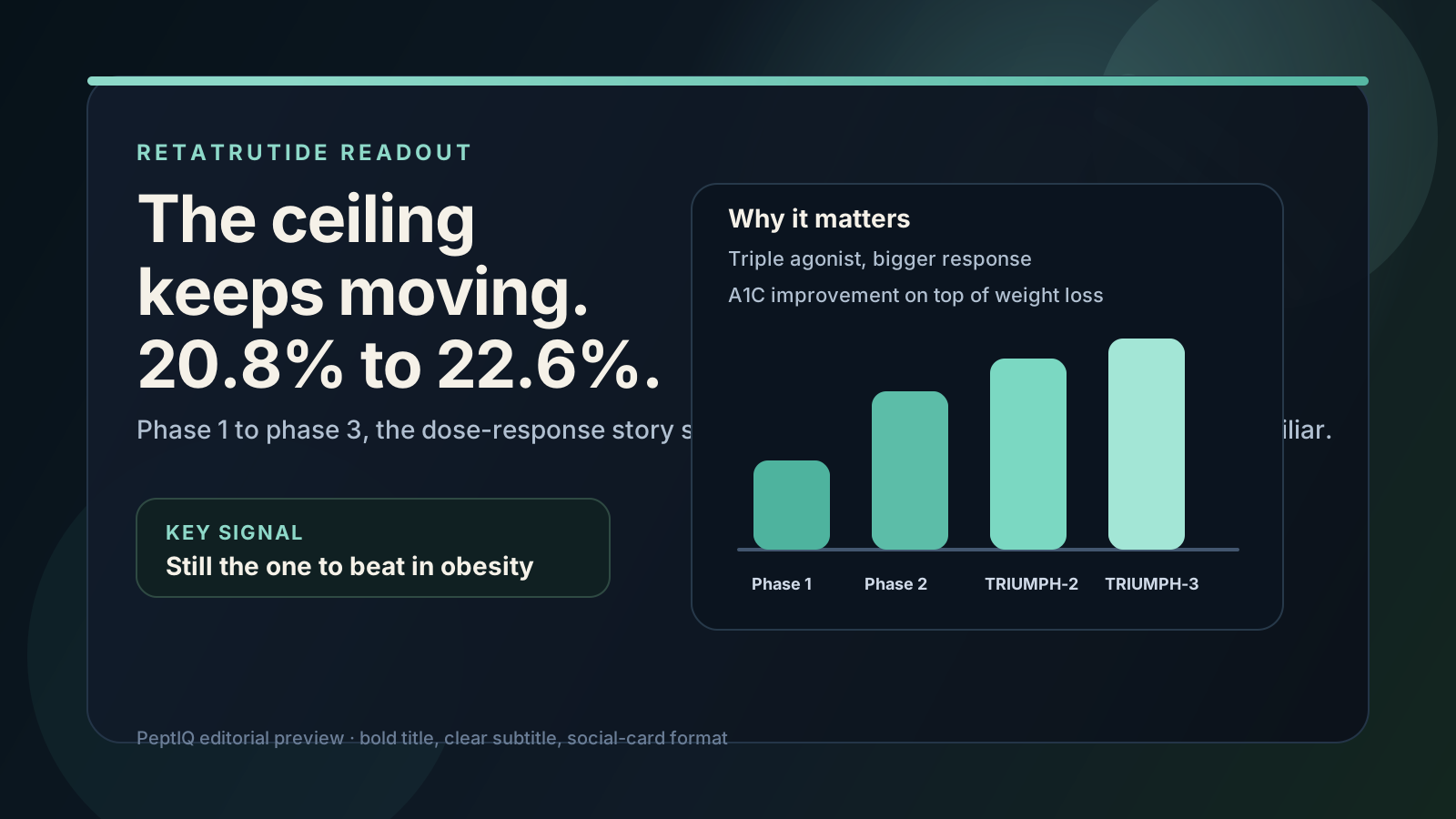
Retatrutide just posted two more strong phase 3 wins. The new numbers matter, but the bigger story is how phase 1, phase 2, and phase 3 now line up into one very clear dose-response story.
 8m
GHK-Cu is not a magic skin fix. It is a copper peptide with a real research trail behind collagen support, tissue remodeling, and wound healing.
 9m
The new BPC-157 review is useful because it separates mechanism from marketing. The peptide looks biologically interesting, but the human evidence is still thin.
 8m
Retatrutide's hype is not just about weight loss. The bigger story is the way a triple agonist can feel different, from warmth and energy expenditure to the GI side effects that shape adherence.
 9m
The peptide conversation is crowded. The useful question is which signals keep showing up in the data and which ones are still mostly hype.
 9m
MOTS-C sits at the intersection of mitochondrial signaling, metabolism, and longevity. July 2026 put it back in the spotlight for a reason.
 8m
The peptide space is loud. This snapshot cuts through the noise and focuses on the compounds that still have real biology behind them.
 8m
MOTS-C may help metabolic signaling in human cells, but the same signal could come with a repair cost. That matters for anyone reading the longevity hype.
 10m
The most useful peptide research is not the loudest. It is the stuff that changes the question from 'does it work?' to 'who does it help, for what outcome, and with what tradeoffs?'
 9m
Healthy aging is not a slogan. It is a measurable question about inflammation, tissue repair, metabolic control, and whether a peptide has human data behind it.
 8m
MOTS-c is not just a mitochondrial story. In human cells, the same signal that turns on metabolism may also dampen repair, which makes context matter.
 10m
Orthopaedics is paying closer attention to peptides because the field keeps running into the same problem: recovery is biology, but biology still needs evidence before it becomes a protocol.
 9m
Tesamorelin has one of the cleanest human-data stories in the peptide space. The new liver fat trial matters because it asks whether that signal extends into fatty liver disease.
 8m
GLP-1s can drive impressive weight loss, but the real win is losing fat without giving up strength. This guide shows how to protect lean mass while appetite is down.
 9m
Sports medicine keeps pulling peptides into the conversation because recovery pressure is real. The hard part is separating promising biology from weak evidence, gray-market hype, and antidoping risk.
 9m
Clinical trials show the headline results. Real-world data shows what happens after the first prescription, after the side effects, and after people try to stay on therapy long enough to benefit.
 8m
GLP-1s can slow gastric emptying, which is why surgery teams now ask different questions. The key is to understand the risk without turning it into fear or hype.
 9m
MOTS-C sits at the intersection of mitochondrial signaling, glucose control, and recovery biology. Here is what the current research can actually support.
 9m
GHK-Cu is more than a cosmetic peptide. The interesting signal is tissue remodeling, matrix repair, and how that may matter for skin, hair, and recovery.
 8m
New MOTS-C data points to something more specific than a generic metabolism story: better muscle mitochondrial efficiency. Here's what that means in practice.
 9m
Retatrutide's weight-loss signal is now strong enough that people are comparing it with surgery. That comparison is useful, but only if you understand what the numbers do and do not mean.
 9m
Retatrutide is no longer just a weight-loss story. The latest kidney-aware review sharpens the question: which metabolic patients need tighter monitoring, slower escalation, and better data?
 8m
MOTS-c is showing up in cardiac stress research. A new rat-heart study points toward mitochondrial bioenergetics, mtDNA integrity, and post-ischemic recovery.
 8m
MOTS-c is moving beyond generic energy claims. New research points toward mitochondrial stress response, lung inflammation, and cardiac reperfusion biology.
 8m
GLP-1 research is moving into healthspan and epigenetic aging. The new semaglutide signal is worth tracking, but it is not proof of age reversal.
 8m
MOTS-c is being studied beyond energy and metabolism. New research points toward tissue-stress biology, lysosomal stability, and cell survival under ischemic pressure.
 8m
GLP-1 research is moving beyond weight loss. New breast cancer risk and survival signals are interesting, but they need careful interpretation.
 8m
The next metabolic peptide wave is not just stronger GLP-1 dosing. Amylin, GIP, glucagon, and combination protocols are changing what serious tracking should include.
 7m
GLP-1 therapy is no longer just GLP-1. CagriSema, cagrilintide, petrelintide, and amycretin show why amylin is becoming a serious metabolic target.
 8m
New 2026 data puts BPC-157 into a sharper recovery frame: oxidative stress, inflammation, apoptosis, angiogenesis, and the limits of animal evidence.
 8m
MOTS-c is moving beyond the generic energy peptide conversation. New 2026 research connects mitochondrial-derived peptides with atrial fibrosis, inflammation, and heart rhythm biology.
 8m
A new MOTS-c pilot study adds a vascular-health signal to the mitochondrial peptide conversation, but it should be read as biomarker research, not a protocol claim.
 7m
GLP-1 peptides are changing the bariatric surgery conversation. The practical lesson is not self-managing around surgery. It is better tracking, clearer handoffs, and coordinated medical planning.
 8m
The new TRIUMPH-1 readout gives retatrutide users a clearer dose-response map: 4 mg, 9 mg, and 12 mg all worked, but the tolerability tradeoffs matter.
 7m
A 2025 Biomaterials Research paper shows GHK-Cu hydrogel achieving full infected wound healing — antibacterial, anti-inflammatory, and neovascularization effects. Here's what the mechanism actually means for regenerative protocols.
 7m
MOTS-c is a peptide encoded in your mitochondrial DNA that declines with age and mimics exercise benefits in animal studies. NAD+ has actual human clinical data. Here's what 2026 research shows about why these two molecules may work together — and what's still missing.
 7m
Dapiglutide is not another simple GLP-1 copycat. The early 2026 trial missed statistical significance for weight loss, but the mechanism points toward the next phase of peptide design.
 8m
New head-to-head trials and real-world data from 2025-2026 reveal tirzepatide and semaglutide are not equivalent - they produce meaningfully different outcomes depending on your goals.
 9m
SLU-PP-332 is a small-molecule ERRα agonist with remarkable endurance, fat oxidation, and mitochondrial benefits. Here's the complete guide to what it does, who it's for, and how to use it.
 9m
Semax is an ACTH-derived peptide that upregulates BDNF and supports neuroprotection. Here's what the research actually shows — and how to track your cognitive protocol.
 8m
Tesamorelin has one of the stronger human-data profiles in the peptide space. A 2026 meta-analysis helps clarify what it improves, what it does not, and how to track the signal honestly.
 8m
Retatrutide is no longer just a weight-loss headline. Current 2026 trial records show researchers testing broader questions: pain, liver disease, cardiorenal risk, dose escalation, and lean-mass preservation.
 7m
Efsubaglutide alfa is a long-acting GLP-1 receptor agonist with new human trial data in drug-naive type 2 diabetes. Here is what the SUPER1 results actually show.
 7m
EDS changes the safety conversation around peptides. GHK-Cu, BPC-157, and TB-500 are discussed for tissue support, but EDS plus cardiac history should stay clinician-led.
 9m
The TRIUMPH-4 trial delivers groundbreaking dual benefits: 28.7% body weight reduction plus significant osteoarthritis pain relief. Retatrutide's triple mechanism may solve two problems simultaneously.
 5m
Educational reconstitution math for NAD+ vials: how diluent volume changes concentration, with worked examples that are not a universal mix or dosing protocol.
 7m
31% body weight loss in a trial participant. Not an average — an individual result. But when 39.4% of Phase 3 participants on the 12mg dose hit the same milestone, the outlier becomes a pattern.
 11m
BPC-157 and TB-500 are the most researched peptides for connective tissue repair—but combining them requires understanding their different mechanisms. Here's the complete stacking protocol based on actual user experience.
 9m
You don't need to have diabetes to benefit from GLP-1 therapy. A comprehensive 2026 systematic review confirms what the peptide community has known for years — and the results are striking.
 8m
MOTS-C timing affects AMPK activation and metabolic benefits. Learn whether to take it fasted, how long to wait before eating, and how to optimize timing for AM or PM training schedules.
 8m
Most people fighting hair loss default to minoxidil. But a 2022 clinical trial showed a 0.5% GHK-Cu serum increased hair count by 22% over 16 weeks — beating 3% minoxidil. And GHK-Cu doesn't just grow hair. It works at the genomic level.
 8m
Finished your GLP-1 cycle and want to maintain metabolic momentum? MOTS-C is one of the most effective peptides for supporting fat oxidation and energy during GLP-1 off-cycles. Here's how to dose and time it.
 8m
The MOTS-C dosing debate is real: 0.5-1mg daily vs 5mg 2-3x weekly. Both protocols have their advocates. Here's what the research says, why context matters, and how to choose the right approach for your situation.
 7m
Peptide therapy searches on TikTok jumped 459% in early 2026. Here's what's driving the explosion, which peptides are trending, and what you need to know before you start.
 7m
Grok says subQ Cerebrolysin doesn't work due to volumes. The real answer is more nuanced — and subQ is viable at research doses if you use the right solvent.
 9m
MOTS-C activates AMPK through mitochondrial signaling. NAD+ feeds the cellular energy substrate. Together, they hit the same system from two different angles — and the results are additive.
 9m
Everyone focused on the 71-pound weight loss stat from TRIUMPH-4. But the buried finding — 75.8% reduction in knee pain scores — may be the more important number for anyone living with joint pain.
 10m
MOTS-C activates AMPK and drives mitochondrial adaptation — but does daily use over months cause your body to stop responding? Here's what the research and user experience actually says about long-term MOTS-C protocols.
 8m
MOTS-C is mitochondria-encoded and activates AMPK through a pathway that's less prone to classic receptor downregulation. Here's how to structure long-term use for sustained results.
 9m
Most peptide users eventually ask: BAC or sterile water? This guide breaks down tradeoffs, timing, and practical decision rules with a peptide-by-peptide reference workflow.
 10m
Epitalon is a lab-made four-amino-acid peptide based on a pineal gland extract. It lengthens telomeres in cell studies, but human evidence is small and old. It is not FDA approved, and since October 2026 it is one of six peptides in an HHS compounding policy.
 9m
GHK-Cu has long been known for its skin and healing benefits. A fresh April 2026 preprint adds a surprising new dimension — cognitive aging reversal in mouse models via BDNF upregulation and neuroinflammation suppression.
 8m
Selank and Semax are two of the most powerful intranasal nootropic peptides available. Here's how they work, how they differ, and the best protocols for using them separately or stacked.
 10m
BPC-157 and TB-500 are the two most evidence-backed peptides for structural tissue repair. For herniated disc recovery, they work through complementary pathways — here's how to stack them, dose them, and phase in the rest of a recovery protocol.
8mMost people who take NAD+ daily wonder whether they should cycle it. The answer isn't black and white — it depends on your dose, delivery method, and goals. Here's what the research and community experience actually suggest.
 8m
Epithalon is one of the most researched longevity peptides in existence, with decades of clinical data behind it. This guide covers the science of telomere elongation, dosing options, cycling protocols, and how it fits into a modern anti-aging stack.
 8m
A Stanford AI tool screened 2,600 uncharacterized peptides and identified BRP — a 12-amino acid molecule that cuts food intake by up to 50%, promotes fat burning, and avoids the nausea, constipation, and muscle loss common with GLP-1 drugs. Here's what the research actually shows.
 10m
Most peptide guides are written with a 35-year-old man in mind. If you're a woman in your 40s or 50s lifting hard and trying to recomp, the stack looks different. Here's what the research actually supports.
 11m
IGF-1 LR3 is a lab-modified copy of the IGF-1 hormone, built in 1992 as a research reagent. A 2026 review places it in the tier with no peer-reviewed human studies at all. It is not FDA approved, is regulated as a biologic rather than a peptide, and is prohibited in sport.
 9m
Tesamorelin is an FDA-approved GHRH analog with clinical trials proving 15–20% visceral fat reduction. Here's the full science, dosing guide, and what the latest research reveals about its longevity applications.
 10m
Most people know GHK-Cu for skin and wound healing. What they don't know: it's one of the most potent epigenetic regulators ever studied, influencing over 4,000 human genes — many tied directly to aging, inflammation, and tissue repair.
 9m
Cerebrolysin is a brain-derived peptide mixture used for neuroprotection and cognitive enhancement. Here's what the research says, how to reconstitute it, and what real protocols look like.
 7m
MOTS-C is one of the most studied mitochondrial peptides for metabolic health and longevity. This guide covers dosing ranges, frequency, timing, stacking options, and what to track on protocol.
 9m
MOTS-c — a peptide synthesized inside your own mitochondria — is now in Phase 2a human trials for prediabetes. Early data suggests it improves insulin sensitivity and metabolic flexibility without the side effects of pharmaceutical interventions.
 10m
Phase 3 trial data is in: retatrutide delivers 28.7% average body weight reduction, outpacing every approved GLP-1 therapy. The numbers tell a clear story about where metabolic medicine is heading.
 8m
SS-31 and MOTS-C target mitochondrial health from two different angles. Here's how to run them together, when to introduce each, and what to expect.
 8m
A complete breakdown of Dihexa — mechanism of action, dosing, what users actually report, and how it compares to Semax and Selank for cognitive enhancement.
 9m
A 2026 Phase 2 clinical trial confirms GHK-Cu achieves 25% faster wound closure and tissue regeneration versus control. Discover how this naturally occurring copper peptide triggers stem cell activity, collagen synthesis, and anti-inflammatory cascades.
9mDiscovered inside mitochondrial DNA itself, MOTS-c is one of the most fascinating longevity peptides in modern science. It governs how your cells produce energy, fight fat accumulation, and age.
 8m
NAD+ and peptides like BPC-157, MOTS-C, and KLOW work through completely different pathways — which is exactly why they stack well. Here's how to combine them safely and effectively.
 10m
The largest systematic review of BPC-157 to date analyzed 36 studies and confirmed consistent healing outcomes across tendons, ligaments, bone, and muscle tissue. Here's what the data shows.
8mBoth MOTS-C and GHK-Cu are popular among serious lifters over 50 — but they work through completely different mechanisms. Here's how to choose, and why the best answer is often both.
 9m
Everything you need to know before your first retatrutide injection — reconstitution math, dose calculations, injection technique, and what to expect if you have prior GLP-1 sensitivity.
 11m
A 2026 meta-analysis comparing retatrutide to GLP-1 (Ozempic/Wegovy) and tirzepatide shows retatrutide delivers 28% superior fat loss. Here's the science behind why the triple-agonist approach is reshaping weight loss and body recomposition.
 7m
GHK-Cu is one of the most researched anti-aging peptides available. Here's a practical dosing guide covering protocols, cycle length, stacking, and what to realistically expect.
 9m
Phase 3 data is in: retatrutide produced an average 28.7% body weight reduction — roughly 71 lbs — in the TRIUMPH-4 trial. Here's what the numbers mean and how the triple agonist mechanism drives these results.
 10m
TB-500 has moved from rodent models to human cardiac recovery trials. The 2026 data is early, but the mechanism and results are worth understanding — especially if you're using TB-500 for recovery.
 11m
BPC-157 activates multiple tissue repair pathways simultaneously. Users report faster recovery from injury, improved gut healing, enhanced joint mobility—backed by published clinical data.
 10m
TRANSCEND confirmed retatrutide as the most effective GLP-1 class compound tested in late-stage trials. 16.8% mean body weight reduction and a 2.0-point A1C drop in 40 weeks — here's what the full data shows.
 9m
MOTS-c is a 16-amino-acid peptide encoded in mitochondrial DNA. It has strong mouse data, one recruiting placebo-controlled human trial and no FDA approval. In October 2026 HHS added it to an interim compounding policy.
 9m
BPC-157 accelerates tissue repair by stimulating angiogenesis and collagen synthesis. Here's what the research shows and what users need to know.
 10m
Retatrutide's triple receptor mechanism simultaneously suppresses appetite, enhances metabolic function, and activates thermogenesis. Here's the science behind why it delivers 24% body weight reduction.
 14m
The peptide space is shifting from weight loss toward longevity. Explore the science behind peptides designed to slow aging, repair cellular damage, and extend healthspan.
 10m
The peptide space is evolving rapidly. Here's what researchers are discovering, which new compounds show promise, and what breakthroughs could hit the market soon.
 10m
Retatrutide is not just a stronger tirzepatide. It's a fundamentally different molecule with three receptor targets instead of two. Here's how each mechanism contributes to rapid fat loss, metabolic optimization, and muscle preservation.
 9m
Retatrutide is often marketed as muscle-sparing. The published scans tell a narrower story: mostly fat loss, some lean loss, and no head-to-head body-composition data against tirzepatide yet.
 12m
Retatrutide and tirzepatide dominate the peptide conversation, but they're not interchangeable. Here's what the latest clinical research reveals about their differences, efficacy, and mechanisms.
 10m
BPC-157 is showing remarkable promise in clinical research for rapid tissue regeneration. Learn how this pentapeptide works, what the data shows, and whether it's right for your recovery protocol.
 8m
New Phase 3 data shows retatrutide delivering superior metabolic benefits. Here's what researchers found and why it matters.
 10m
Retatrutide, the triple-action GLP-1/GIP/glucagon receptor agonist, outperforms tirzepatide by 23% in the latest human clinical trial—the most comprehensive weight loss comparison to date.
 10m
Retatrutide is a next-generation weight loss peptide targeting three metabolic pathways. Here's how it works and why it outperforms earlier GLP-1 therapies.
12mBPC-157 shows promise in clinical research for accelerating tendon repair and recovery. Learn how this peptide works and what the science says about its efficacy.
10mMOTS-C activates mitochondrial function and metabolic pathways linked to longevity and improved physical performance.
 12m
BPC-157 is the most versatile healing peptide available. Here's how it works and how to use it effectively.
 12m
GLP-1 agonists have revolutionized metabolic health. Learn how these peptides work, their effects on metabolism, and how to use them strategically for body composition goals.
 18m
From BPC-157 and GLP-1 agonists at the top to overhyped flops at the bottom — here's every major peptide ranked for 2026 across fat loss, skin, longevity, and recovery.
 10m
The complete guide to safely reconstituting peptides, including dosage calculations and best practices.
 12m
Explore the healing peptide BPC-157, nicknamed the 'Wolverine peptide' for its remarkable regenerative properties.
 10m
Discover how TB-500 promotes tissue repair, reduces inflammation, and supports recovery from injuries.
 9m
Explore why Ipamorelin is considered the gentlest yet effective growth hormone releasing peptide available.
 8m
Learn where and how to inject peptides safely with our comprehensive injection site guide and rotation protocol.
 7m
Maximize your peptide investment with proper storage techniques that maintain potency and extend shelf life.
 9m
Learn why Sermorelin is a popular choice for natural GH optimization and anti-aging protocols.
 11m
Explore how Semaglutide has revolutionized weight management through GLP-1 receptor agonism.
 7m
Understand why bacteriostatic water is essential for peptide reconstitution and how to use it properly.
 12m
Discover the scientific foundation behind using GH peptides for anti-aging and longevity optimization.
 9m
Learn about Melanotan 2, the peptide that stimulates melanin production for UV-free tanning effects.
 8m
Discover how AOD-9604 targets fat metabolism specifically, offering a focused approach to body composition.
 7m
Learn how to select the perfect insulin syringe for your peptide protocol with our comprehensive guide.
 9m
Learn about common peptide side effects, how to minimize them, and when they require attention.
 8m
Discover Tesamorelin, the only FDA-approved GHRH peptide, specifically indicated for reducing visceral fat.
Also available at /blog for legacy links.