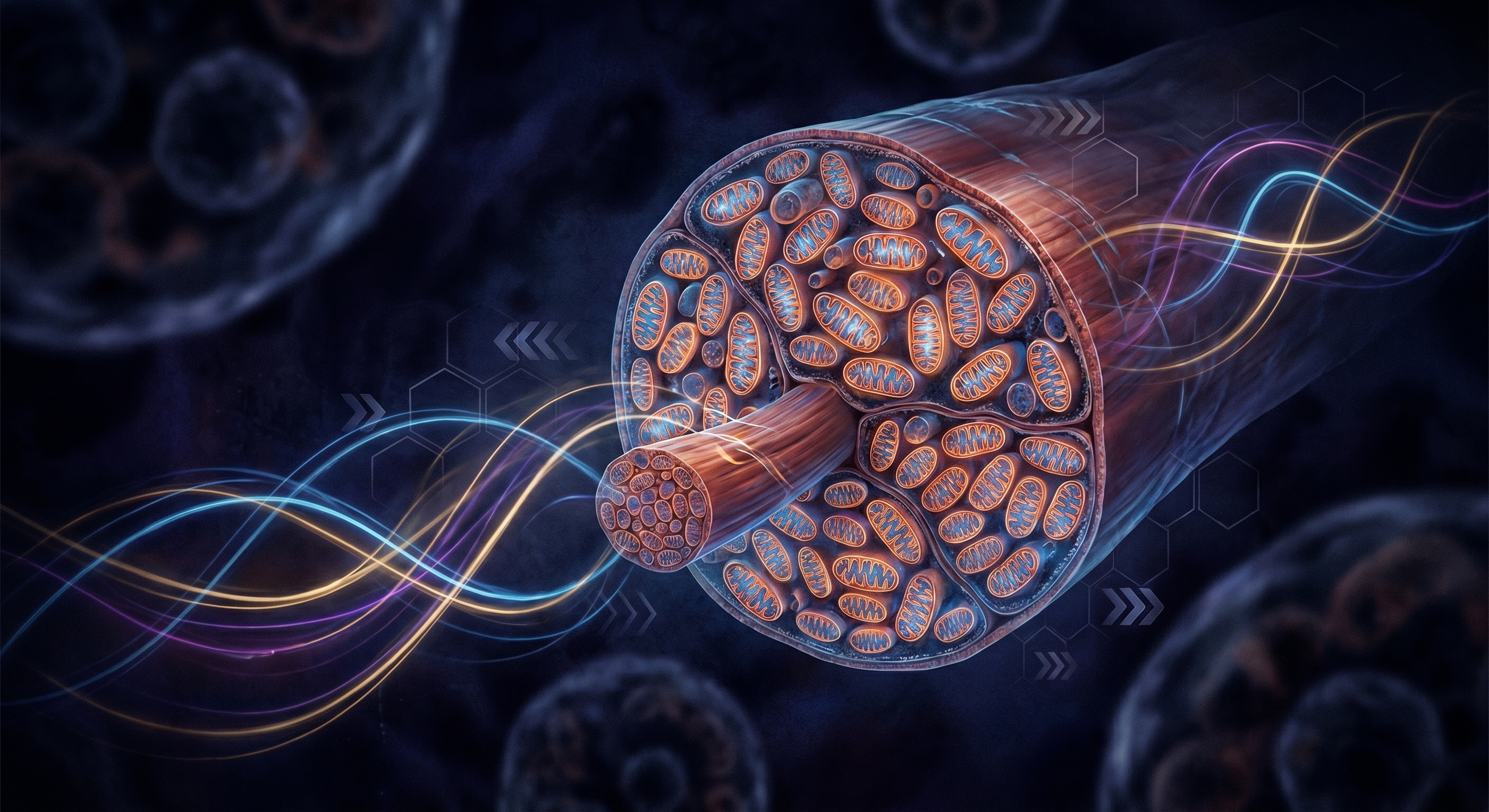
MOTS-C and Muscle Mitochondrial Efficiency: What the New Data Means
A closer look at new MOTS-C research suggesting improved intrinsic muscle mitochondrial bioenergetic health, and why that matters for energy, endurance, and aging.
PeptIQ Team
Peptide Research & Education
PeptIQ app
Track your peptide protocols in PeptIQ
Log injections, vial supply, and reminders. Use peptiq.io calculators when you need math on the web.
# MOTS-C and Muscle Mitochondrial Efficiency: What the New Data Means
MOTS-C keeps showing up in peptide conversations for one reason: it sits close to the machinery that decides whether a cell feels energetic or sluggish.
That is why a new study on intrinsic muscle mitochondrial bioenergetic health and efficiency is interesting. It pushes the discussion beyond broad "metabolism" language and into the part of the cell that actually makes energy.
The short version is simple: this is not just another peptide headline about weight loss. It is a signal that MOTS-C may be doing something more specific inside muscle tissue, especially around how mitochondria handle fuel, stress, and recovery.
---
What the New Data Suggests
The headline result is about intrinsic muscle mitochondrial bioenergetic health and efficiency. In plain English, that means the muscle cells' energy systems appear to be working better, not just harder.
That distinction matters.
A lot of supplements and compounds can make you feel stimulated. Far fewer seem to improve the quality of energy production itself. MOTS-C is interesting because the signal points toward:
Better mitochondrial output per unit of fuel
Improved cellular stress handling
More efficient energy use inside muscle tissue
A pathway that may overlap with exercise adaptation rather than replace it
The study also ties MOTS-C to PGC-1α and AMPK, two of the most important nodes in metabolic biology. Those pathways show up whenever researchers talk about endurance adaptation, mitochondrial biogenesis, and the shift from passive energy storage to active energy turnover.
That does not mean MOTS-C is "exercise in a vial." It means the biology is landing in the same neighborhood as the systems that make training work.
---
Why PGC-1α and AMPK Matter
If you strip away the jargon, these are the two reasons the study got attention.
AMPK
AMPK is the cell's energy sensor. When energy is low, AMPK turns on the programs that help the cell:
Burn fuel more efficiently
Increase glucose uptake
Favor fat oxidation
Reduce wasteful energy use
That is one reason AMPK is often described as a master metabolic switch.
PGC-1α
PGC-1α is closely associated with mitochondrial biogenesis and endurance adaptation. When it is active, muscle tends to get better at making and using energy over time.
This is the part that interests athletes, aging researchers, and anyone tracking body composition:
More mitochondria
Better mitochondrial quality
Better fatigue resistance
Better adaptation to exercise stimulus
If MOTS-C influences both AMPK and PGC-1α signaling in muscle, it is not just nudging metabolism. It may be helping the cell rebuild its energy infrastructure.
---
What This Means in Practice
The real-world interpretation is narrower than the social media version.
This new data does not prove that MOTS-C will:
Replace training
Build muscle on its own
Cause rapid fat loss by itself
Deliver dramatic human outcomes from one protocol
What it does suggest is more useful:
MOTS-C may be more relevant for energy efficiency than for appetite
Muscle tissue may be a primary target, not just a downstream beneficiary
The peptide may fit better into performance and aging conversations than into hype-driven fat loss claims
That makes it especially interesting for people who care about:
Endurance and recovery
Age-related energy decline
Body recomposition
Training adaptation while cutting
Metabolic resilience
If your question is "What actually helps cells make better energy?" this study gives MOTS-C a stronger place in the conversation.
---
How MOTS-C Differs from Other Popular Peptides
MOTS-C is easy to lump in with other metabolism peptides, but it plays a different role.
Versus GLP-1s
GLP-1 drugs mainly act through appetite, glucose regulation, and weight-loss signaling. MOTS-C is more about cellular energy handling and mitochondrial efficiency.
That means the two are not direct competitors. They solve different problems.
Versus Tesamorelin
Tesamorelin is a more direct body-composition tool, especially for visceral fat. MOTS-C is more about the engine underneath body composition: how muscle cells produce and spend energy.
Versus GHK-Cu
GHK-Cu is a repair and remodeling story. MOTS-C is an energy and adaptation story.
Versus BPC-157
BPC-157 is the injury and tissue-repair peptide. MOTS-C is the metabolic efficiency peptide.
That is why MOTS-C keeps getting pulled into stack discussions. It fills a different lane.
---
Who This Is Most Relevant For
The new data is most useful for people in three buckets.
1. People chasing performance
If you care about endurance, interval tolerance, or recovery between sessions, mitochondrial efficiency matters. Energy production is the bottleneck behind a lot of "I feel flat" complaints.
2. People trying to preserve muscle during fat loss
Cutting phases expose inefficiencies fast. If a peptide can help muscle tissue work more efficiently, it may be more useful than something that only changes scale weight.
3. People looking at aging through a metabolic lens
Age-related energy decline is often presented as fatigue, but underneath that is mitochondrial drift. Anything that points toward better mitochondrial function is worth watching.
---
The Caution
The caution is the same one that applies to almost every interesting peptide study:
Mechanism is not the same as finished clinical utility.
MOTS-C has a compelling story. That story is getting more specific. But the jump from mitochondrial bioenergetics in a study to a reliable real-world protocol still depends on:
Replication
Human data
Dose clarity
Safety over time
Practical effect size
That is why serious peptide readers should stay excited but not sloppy.
The best interpretation is not "MOTS-C is proven." The best interpretation is "MOTS-C is becoming easier to understand."
---
Frequently Asked Questions
Q: Is MOTS-C mainly a fat loss peptide?
A: Not really. It may support body recomposition, but the more interesting signal is mitochondrial efficiency and metabolic resilience inside muscle tissue.
Q: Does this study prove MOTS-C works in humans?
A: No. It improves the mechanistic case, but it does not replace human outcome data. It tells us where to look next.
Q: Why do AMPK and PGC-1α matter so much?
A: They are central regulators of energy sensing and mitochondrial adaptation. If those pathways improve, cells usually get better at handling stress and producing usable energy.
Q: Who should pay attention to this research?
A: People focused on endurance, aging, metabolic flexibility, and recovery. If you care about how the engine works, not just how fast the vehicle goes, this is relevant.
Q: How should I think about MOTS-C compared with GLP-1 drugs?
A: GLP-1s are mostly appetite and metabolic control tools. MOTS-C is more of a cellular efficiency and adaptation signal. They solve different problems.
---
Bottom Line
This new MOTS-C research matters because it moves the peptide from vague metabolic hype toward a more precise biological story.
The story is not "MOTS-C makes you lean overnight." The story is stronger than that:
MOTS-C may help muscle mitochondria work better, and that could matter for endurance, recovery, aging, and body recomposition.
That is exactly the kind of signal worth paying attention to in 2026.
If you want to track compounds like MOTS-C with actual dose logs, protocol notes, and outcome tracking, download the PeptIQ app.